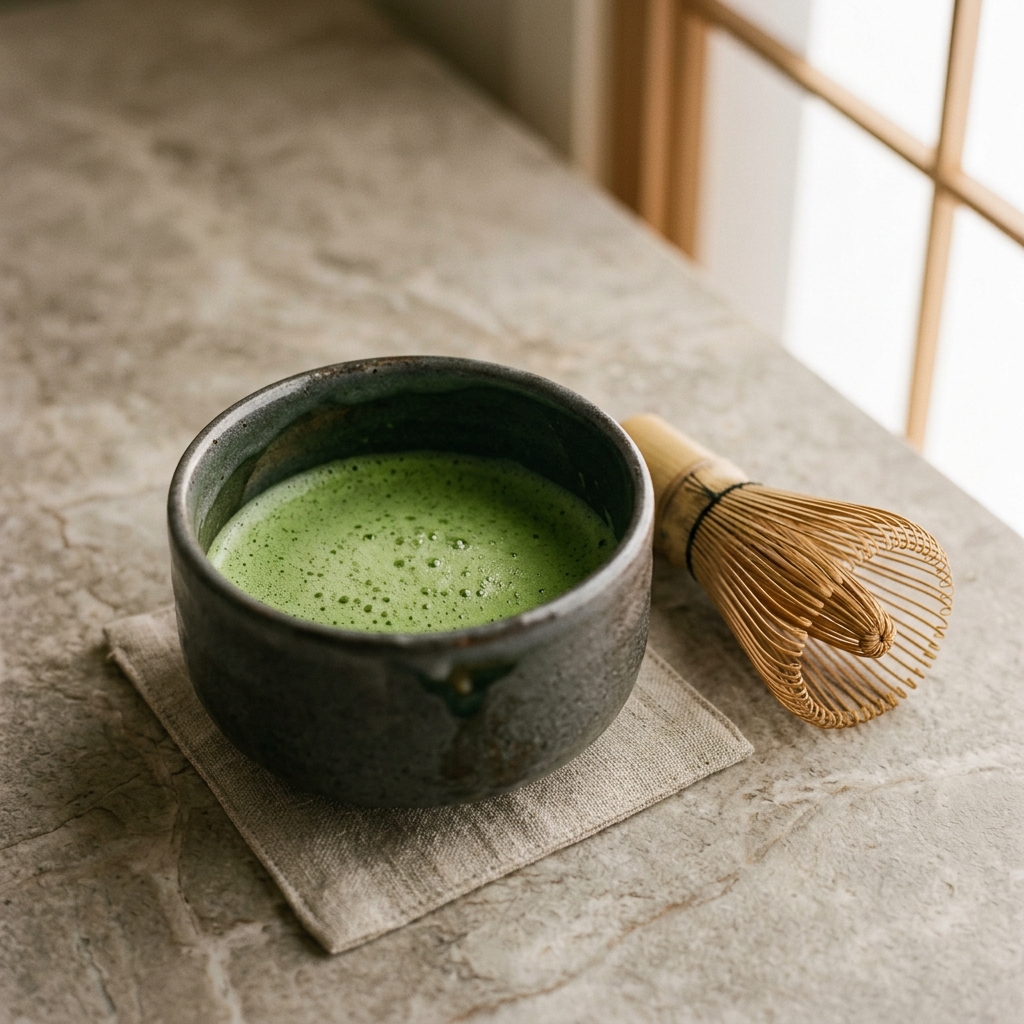
Whisking is the final physical act of translation. It is the moment where dry, quiet green dust and warm water are unified into a vibrant, frothy elixir. While it seems simple, mastering the whisk—the traditional bamboo Chasen—is a delicate blend of technique, posture, and rhythm. The goal is to achieve a velvety micro-foam that softens the tea's natural bitterness and enhances its creamy mouthfeel.
In Chado, the way you handle the whisk is indicative of your state of mind. A forced, tense whisking produces large, unstable bubbles; a relaxed, precise whisking yields a thick, persistent micro-foam resembling jade silk.
"The whisk does not beat the tea; it coaxes the water and the dust into a single, unified breath."— WHISKING MASTERY
The Anatomy of the Chasen
The bamboo whisk, or Chasen, is a masterpiece of design. Carved from a single piece of seasoned bamboo, it features dozens of delicate, curved tines (often 80, 100, or 120). These thin, flexible tines cut through the water, breaking down clumps of powder and incorporating air to create tiny bubbles.
Unlike a metal whisk, the bamboo tines are designed to flex. They sweep the bottom and sides of the ceramic bowl (Chawan) gently, ensuring that no unwhisked powder remains, without scratching the glaze.
Mastering the "M" Motion
The most common mistake is to whisk in a circular motion, as one would beat an egg. Whisking in circles creates a lazy vortex that fails to aerate the tea, leaving large, soapy bubbles on the surface.
Instead, the correct technique uses a rapid, linear back-and-forth motion resembling the letter "W" or "M". This angular movement cuts the water repeatedly, creating turbulence that efficiently traps microscopic air bubbles.
The Choreography of the Hand
Keep your shoulder dropped, your arm heavy and relaxed, and let the movement come entirely from a loose, flexible wrist. Whisk vigorously for 30 to 45 seconds, keeping the tines suspended just above the bottom of the bowl to avoid damaging them.
As the froth thickens, slowly lift the whisk toward the center of the bowl to draw the larger bubbles to the top, finishing with a gentle, circular sweep.
Thin vs. Thick: Usucha & Koicha
Whisking techniques differ depending on whether you are preparing Thin Tea (Usucha) or Thick Tea (Koicha). Usucha requires a rich, creamy micro-foam that balances the flavor.
Koicha, which uses double the powder and half the water, is not whisked to foam at all. Instead, the whisk is used in a slow, circular kneading motion to create a glossy, syrup-like green paint.